Optimising Your Affiliate Marketing Landing Page Using SEO, CRO, & GEO
08-09-2026
Whether you want to succeed as an affiliate marketer, blogger, or influencer, you likely need well-optimised landing pages to drive conversions and sales. Back in the day, basic conversion rate optimisation (CRO) practices were enough to create a high-converting landing page: add metadata, place headings strategically, use keywords here and there, and that was it.
Now, since more than 68% of searches end without clicks, you also need to optimise your page for generative engines – generative engine optimisation (GEO) – all while tracking your performance and acting on collected insights.
Read on to learn more about how SEO, CRO, and GEO principles apply in 2026 and how you can get the most out of your landing pages in 2026 and further.
How to Create a High-Converting Landing Page
From enhancing your copy and visuals to A/B testing, conversion rate optimisation is a set of practices designed to reduce friction and ensure every page element works together to move a user toward conversion.
The following CRO practices are recommended for affiliate marketing landing pages.
Write Persuasive Copy
A good landing page copy rests on three core principles:
– Personalisation: Define your ideal customer profile (ICP), including pain points and buying triggers, and then build your content creation around it. If you’re in B2B, also factor in tech stacks, company size, and operating models.
– Style: Use wording familiar to readers, follow a clear, logical structure, and avoid overly long sentences. Produce digestible content that is easy to read and engaging.
– Trust signals: Amplify your message with trust signals – testimonials, case studies, reviews, and anything else that proves your credibility and the credibility of the business you promote. If you didn’t receive these materials during onboarding, feel free to ask your affiliate manager for them.
Choose the Right Visuals
The number one thing you want from your visuals is to look professional without being over the top. You can achieve this by using muted colours for your background and something more prominent for key interface elements, like lead capture forms and CTAs.
Images-wise, they should complement what you promote. For example, if you promote software, show the most important panels and operational capabilities; if you promote legal services, use a photo of a real satisfied client.
Also, don’t forget that your brand palette should be harmonious, which you can achieve by following the colour theory.
Streamline Page Layout
Your affiliate marketing landing page should be easy to follow. The gold standard here is the Z-pattern, a blueprint that sequences text blocks and images across a conditional two-column grid, helping you deliver content gradually, without overwhelming users.
Other than that, your images and info blocks should follow a logical sequence like this:
- Title, subheadline, and call to action
- Primary (hero) image
- Trust signals
- Features and benefits
- Closing CTA
Optimise Page Speed
In the fast-paced digital age, most users would rather leave a website than wait more than 2-3 seconds for a landing page to load.
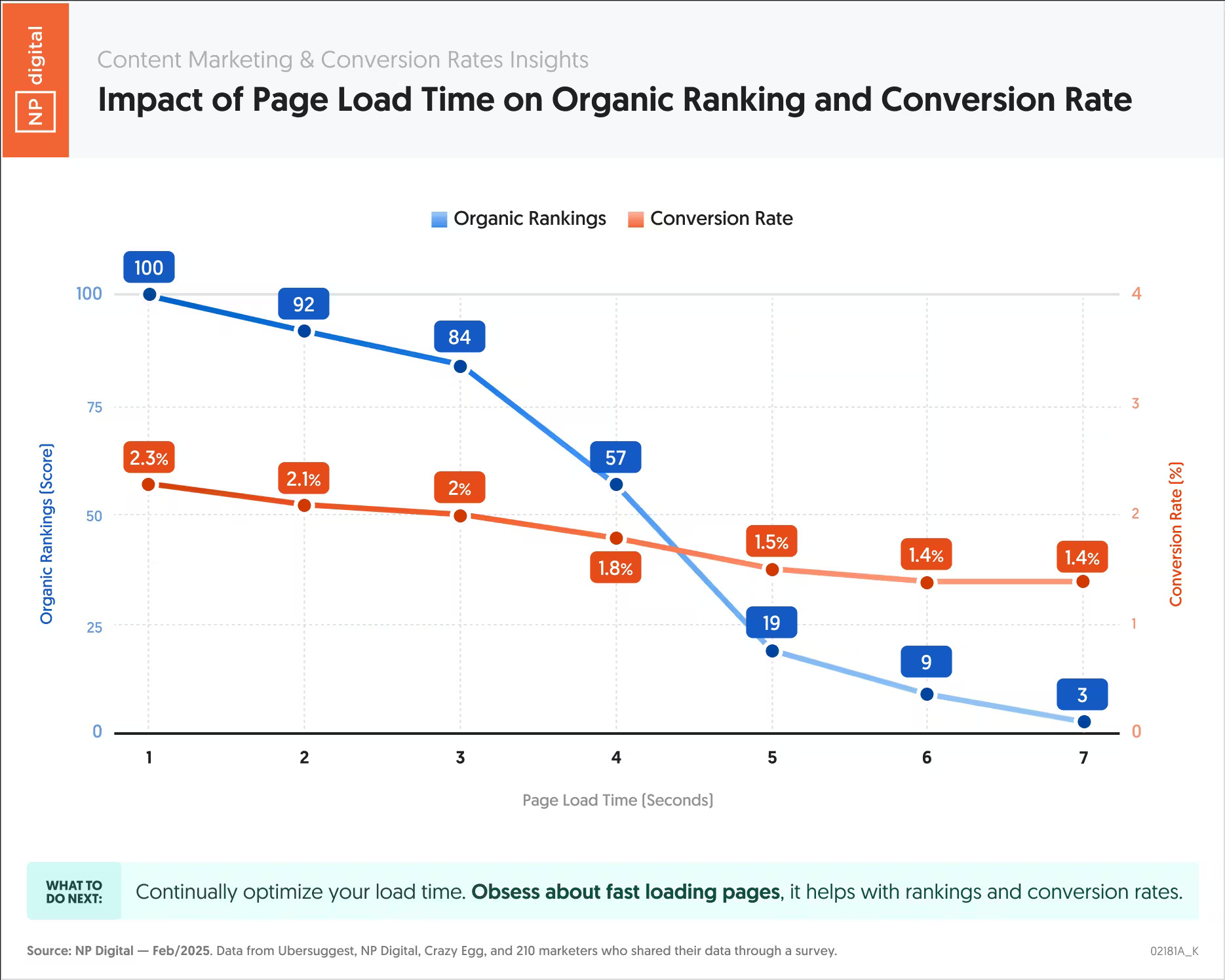
Source: neilpatel.com
These practices help prevent your page speed from eroding your conversion rates:
– Measure your time-to-first-byte (TTFB) and, if it exceeds 600 milliseconds, upgrade your hosting
– Convert images into WebP or AVIF formats to compress them without sacrificing quality
– Ensure your visual elements load only when they should appear on the interface
– Combine server-side and browser caching to deliver media with fewer processing requests
– Use content delivery networks if your website targets users across geographically distributed regions
Adapt for Mobile
The dominance of mobile traffic is obvious, so there’s no debate as to whether you should optimise your landing pages for mobile phones. However, mobile responsiveness alone may no longer be enough – you also need to make the design as simple and concise as possible.
Since mobile screens are much smaller than on desktop, every pixel counts and should serve one main purpose – to drive users toward conversion. That’s why layouts with a title, trust signals, product benefits, and a CTA in a single view work well here.
You also want to keep pages shorter so users can find what they need more easily. For that reason, consider using dropdowns, carousels, and other elements that can hold a lot of information without taking up much space.
CRO Software
Beyond helping personalise content, segment audiences, and build sales funnels, CRO software can record web sessions to uncover which page elements work as intended and which create friction and drop-offs. Most of these software solutions also include A/B testing, splitting traffic between two web page versions and measuring their performance so you can deploy the best one.
These CRO tools are worth considering:
– VWO: AI-powered solutions with over 125 features, including split testing, performance tracking, error spotting, and more.
– PostHog: Tool for monitoring engagement, conversions, and behavioural patterns, bundled with testing and debugging tools.
– Zoho PageSense: Unified platform for optimising conversions, tracking and analysing results, and personalising web experiences.
Search Engine Optimisation

Search engine optimisation is the practice of improving your site’s on-page, off-page, and technical elements to build domain authority and secure higher positions in search engine results pages (SERPs).
Although SEO doesn’t affect conversion rates as much as CRO, it helps you drive more traffic to your landing pages, thereby increasing the overall number of conversions and profit.
On-Page SEO
On-page SEO encompasses practices performed on a web page:
– Research keywords that align with the targeted search intent and audience
– Keep a title up to 60 characters long, a meta description up to 160 characters, and write alt text for images
– Devise a URL slug that describes your page with a few spot-on words
– Divide copy into 3 – 4-line paragraphs and use tables, bullet points, and numbered lists
– Create helpful, unique, and experience-based content that matches the intent
– Use targeted keywords in the title, meta description, and headers
– Interlink your pages and add external links to credible sources
Off-Page SEO
With off-page SEO, your main goal is to build backlinks to your website from high-authority domains. One way to do this is to produce quality content – industry reports, infographics, study/research-based charts, free tools, expert interviews, etc – that creators will reference naturally.
Guest posting, paying site owners to post articles linking to your website, is another way to get backlinks. The price depends on the donor site’s authority, and you typically need to produce an article yourself, according to editorial guidelines. That said, be careful with Google’s link spam policies. They prohibit and can penalise guest posting, so it’s best to pitch only valuable publications and do so incrementally.
Other off-page SEO practices include generating brand mentions, citations, customer reviews, and social media engagement.
Technical SEO
Technical SEO, in turn, refers to a set of practices aimed at optimising your site’s infrastructure, so that search engines can crawl, index, and display your pages:
– Schema markup: JSON-LD code that helps search engines understand your page’s content. You can produce schema markup with specialised tools or AI.
– XML sitemap: XML document that maps out your website structure, making it easier for crawlers to find and index your landing pages. Sitemaps are stored on dedicated URLs.
– Robots.txt: Plain-text document that signals to search engines that they can access your landing pages. Similar to an XML sitemap, Robots.txt has its own URL.
Likewise, you should take care of your web vitals and optimise your page for mobile, which we already covered in the CRO sections.
SEO Software
SEO software is indispensable for finding the right keywords, researching competitors, monitoring indexing, checking backlink statuses, measuring domain authority, and much more.
The best SEO tools are:
– Google Search Console (GSC): Google’s free tool that provides first-party ranking data and keeps a finger on the pulse of your web vitals.
– Ahrefs: Amazing for competitor and backlink research, offering a site audit tool that highlights where your SEO strategy falls short.
– Semrush: All-rounder with robust keyword, competitor, and market research tools, accompanied by local SEO features and backlink analytics.
Generative Engine Optimisation
With the advent of AI Overviews and AI Mode in Google, users’ search behaviour has changed. Now, only around 30% of users explore SERPs – the rest interact with AI responses without clicking a single link.
For publishers, it means reimagining their content strategy to show up in AI outputs. Key factors here are brand mentions, customer reviews, content freshness, original research, personal experience, and entity authority. No less importantly, your content should be original so it doesn’t blend with the competition and get cited by AI more often.
The good news is that GEO tracking functionality is typically built into SEO software, which can now track AI brand mentions, show how much traffic comes from LLMs, and even surface AI brand sentiment.
Affiliate Performance Tracking
If you’ve been in the affiliate industry for a while, you should know that by default, some of your conversion data belongs to advertisers. In this scenario, you’re reliant on partner reports and can’t optimise your pages properly, let alone in real time.
Affiliate tracking tools combine postback URLs, tracking pixels, and API integrations to give you full data ownership and deliver performance insights the moment they become available.
Through unified, dynamic dashboards, these tools surface business metrics, device, browser, and geographic data, conversion time, and similar details. You can use them to optimise your pages right away. For example, by knowing that most of your traffic comes from a specific area, you can target relevant keywords and adapt your content to local nuances.
Consider these affiliate tracking tools:
– Voluum: Tracking software operating on postback URLs and offering a robust media-buying toolkit.
– RedTrack: Unified performance marketing system for server-side tracking, cross-channel attribution, and analytics.
– Keitaro: Monitoring solution with reporting, attribution, API, and ad tracking features.
Become an affiliate with t.uk to gain access to exclusive marketing materials, receive competitive bi-weekly payouts, and get 24/7 help from industry experts.
For more information, call 01202 122 280 or email us at info@t.uk.
Frequently Asked Questions
What makes a good landing page?
In short, a good affiliate marketing landing page must be well written and structured, mobile-friendly, and fast-loading. It should also attract targeted traffic, which requires proper SEO or paid advertising.
Do you need help from an affiliate manager to launch an affiliate marketing landing page?
If your affiliate program requires you to use specific marketing assets or follow other rules, you may need to reach out to an affiliate manager for clarification or access to those assets. Everything else is on you.
What are the best tools to create an affiliate marketing landing page without coding?
With tools like Leadpages, Systeme.io, and Carrd, you can use proven templates and customise them via intuitive drag-and-drop builders to create an affiliate marketing landing page you need without code.
 63
63